Visualize hidden Markov model and threshold results
Source:R/create_threshold_plots.R
create_threshold_plots.RdExtends the visualizations from create_hmm_plots() by adding
horizontal or vertical dashed lines representing the calculated QUEST
thresholds.
Arguments
- list_results
An object of class
epiquest_thresholdsproduced byrun_threshold_computation().A logical. If
TRUE, all generated plots are printed to the active graphics device.
Value
An object of class epiquest_plot_list, a named list of ggplot2 objects,
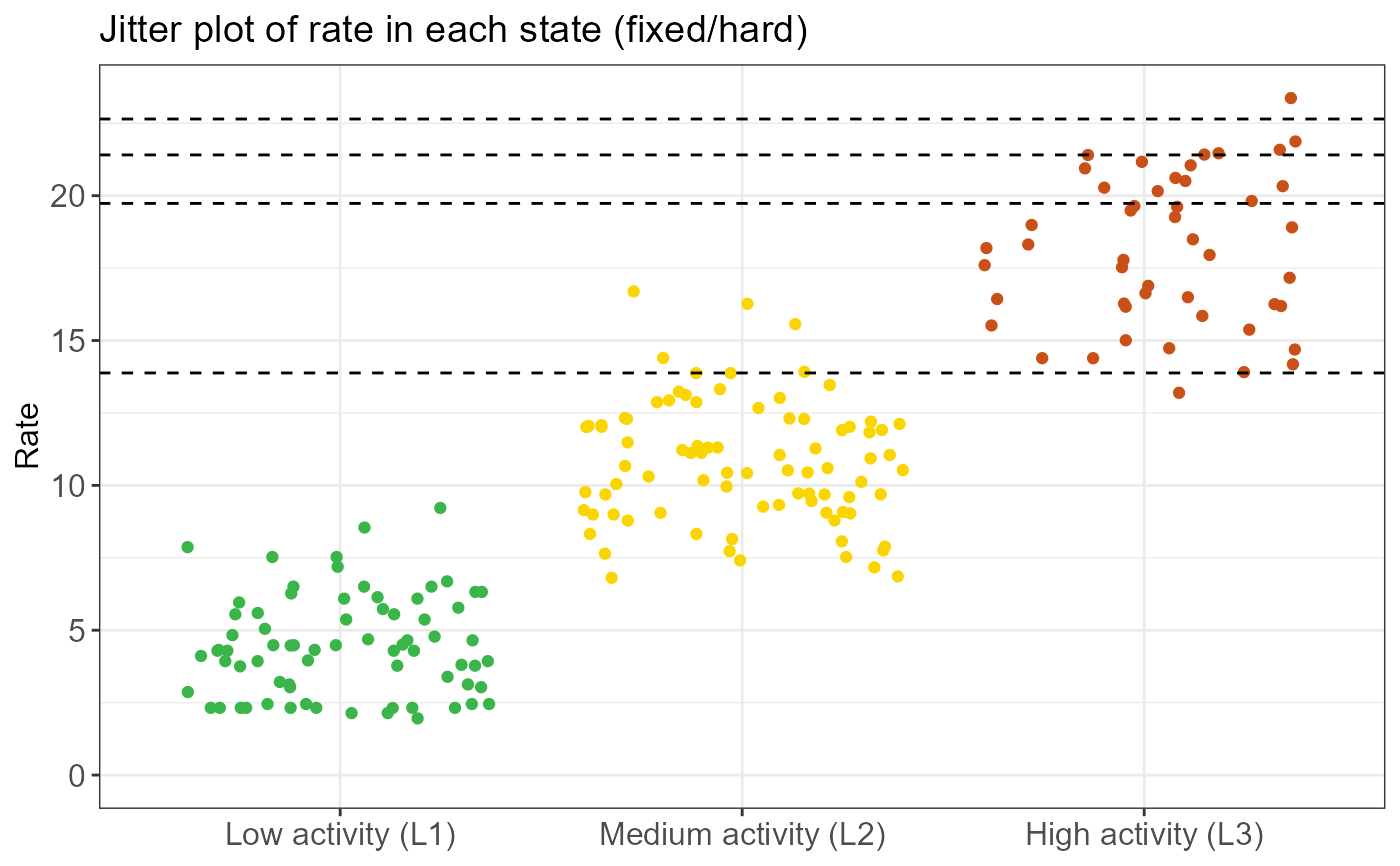
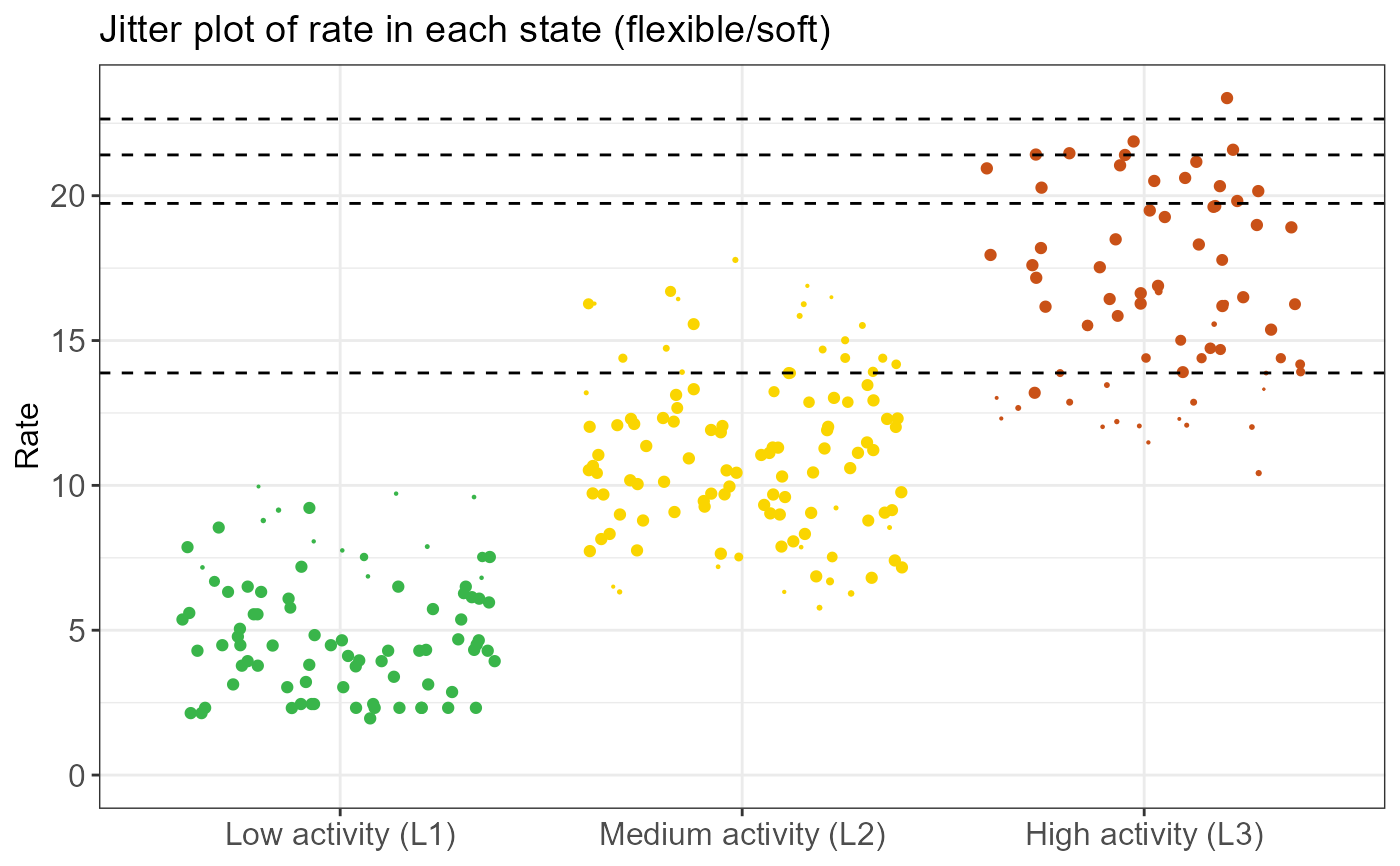
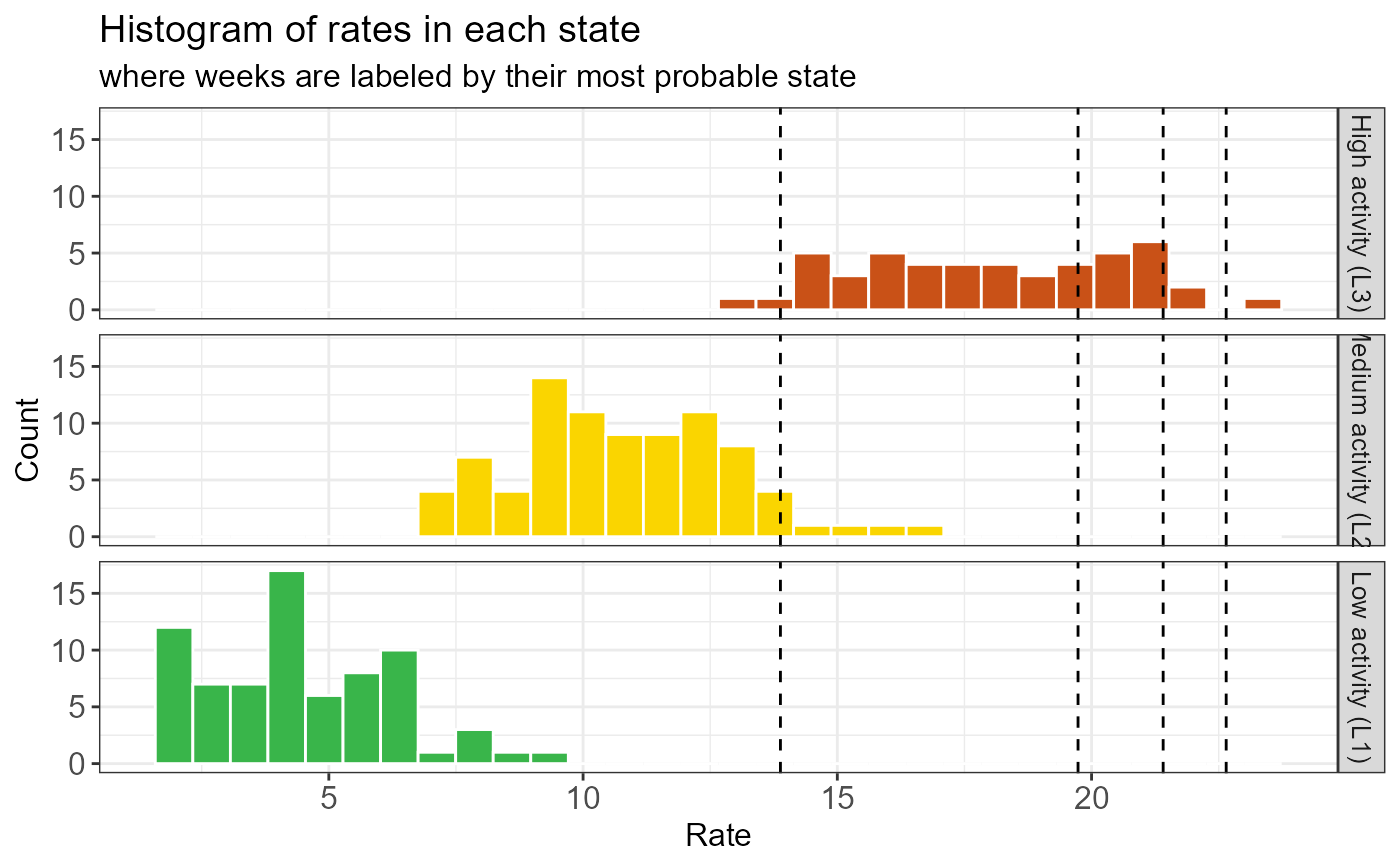
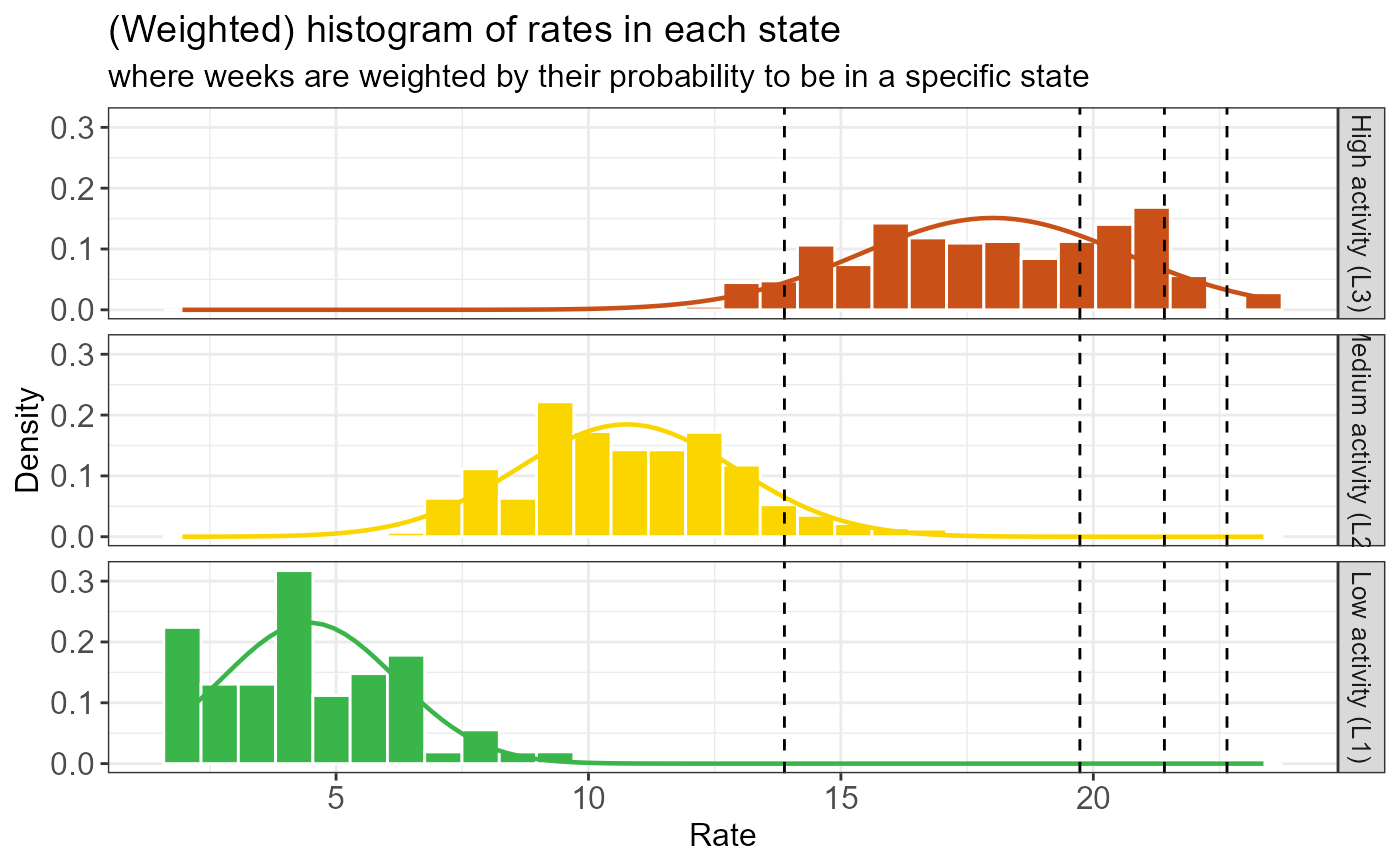
identical in structure to the output of create_hmm_plots(), but with threshold lines added to:
jitter_hard/softhistogram_hard/softtime_series_per_statetime_series_full
Details
This function first calls create_hmm_plots() to generate the base
visualizations. It then overlays dashed lines corresponding to the
thresholds stored in the list_results object.
Examples
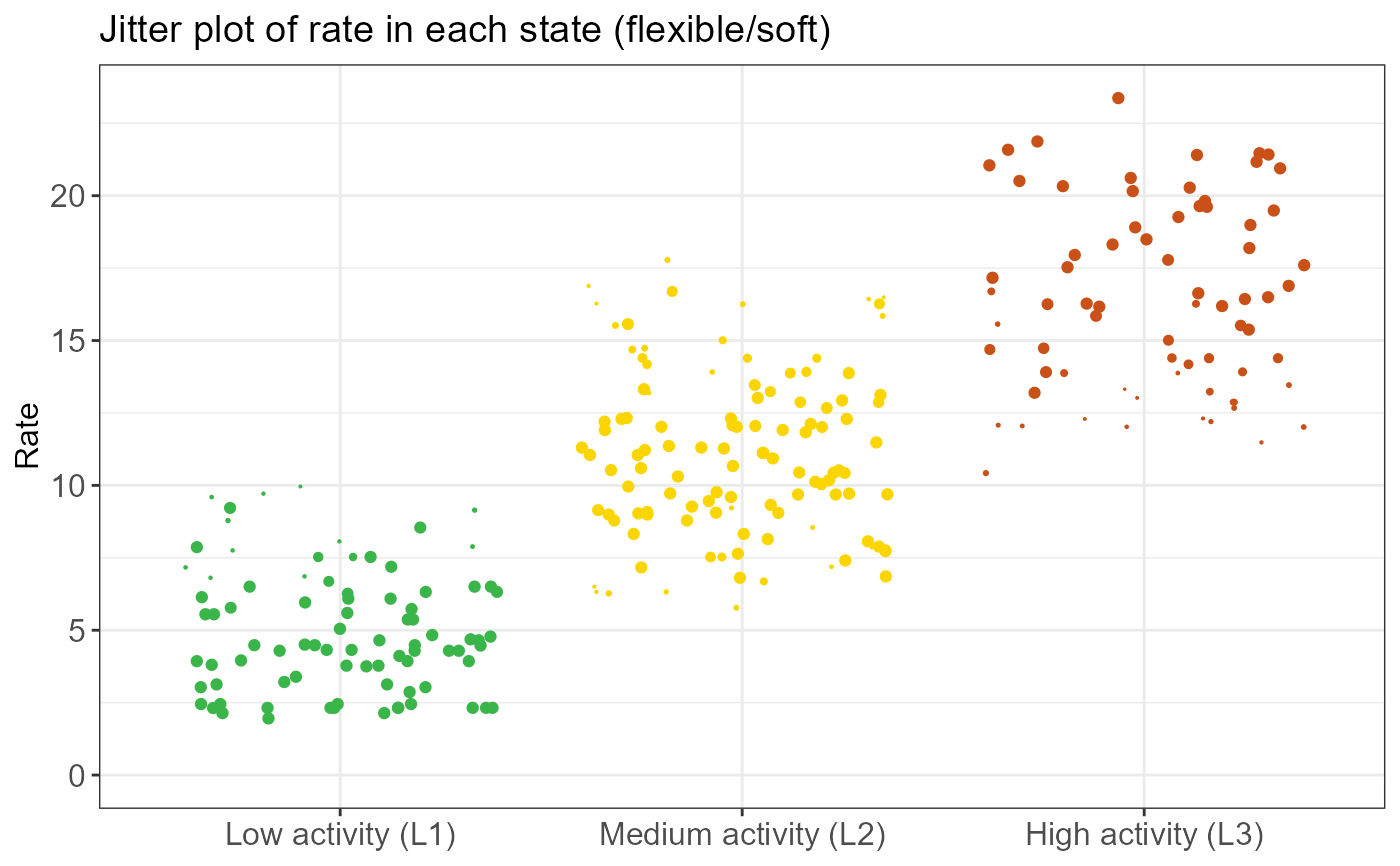
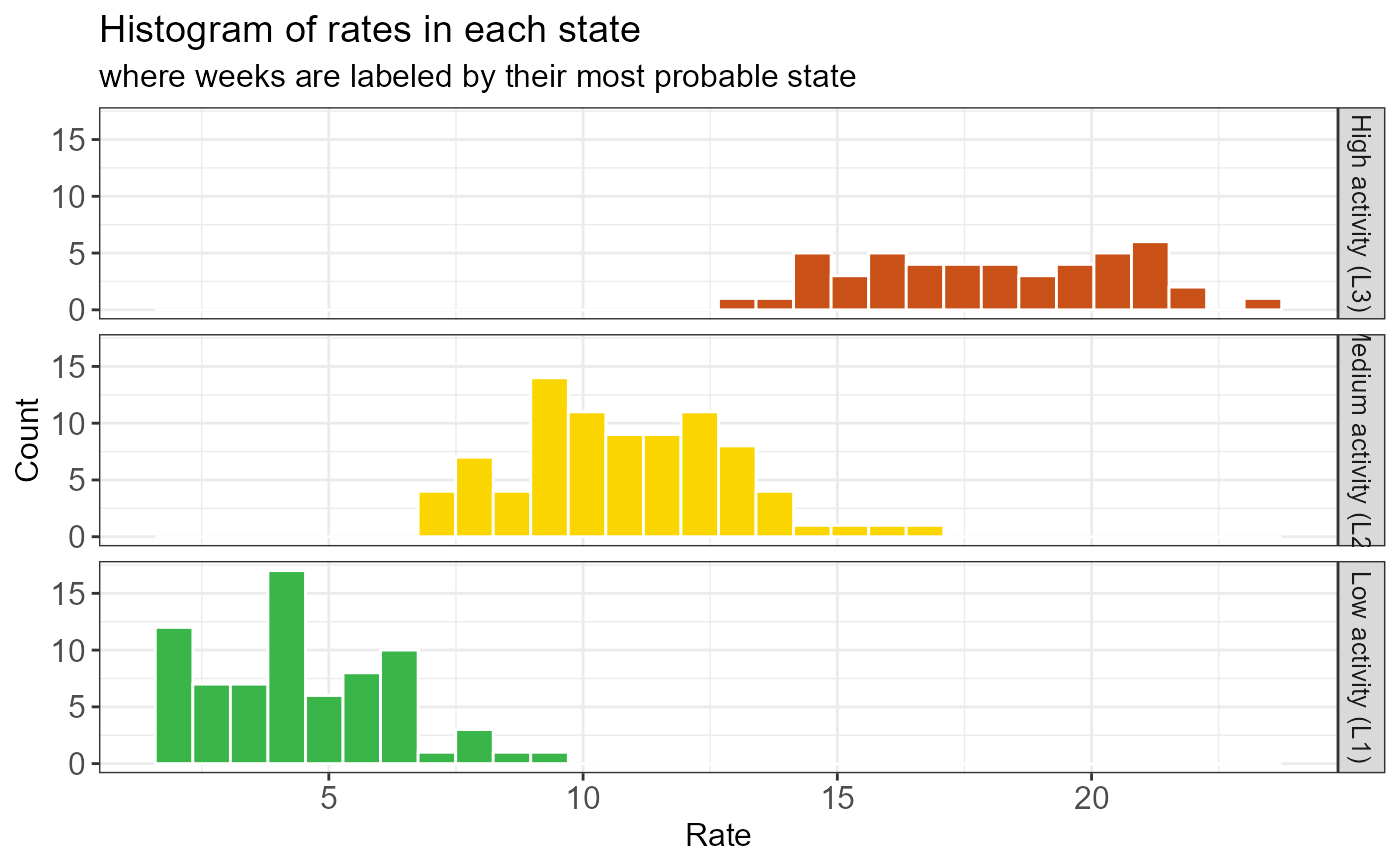
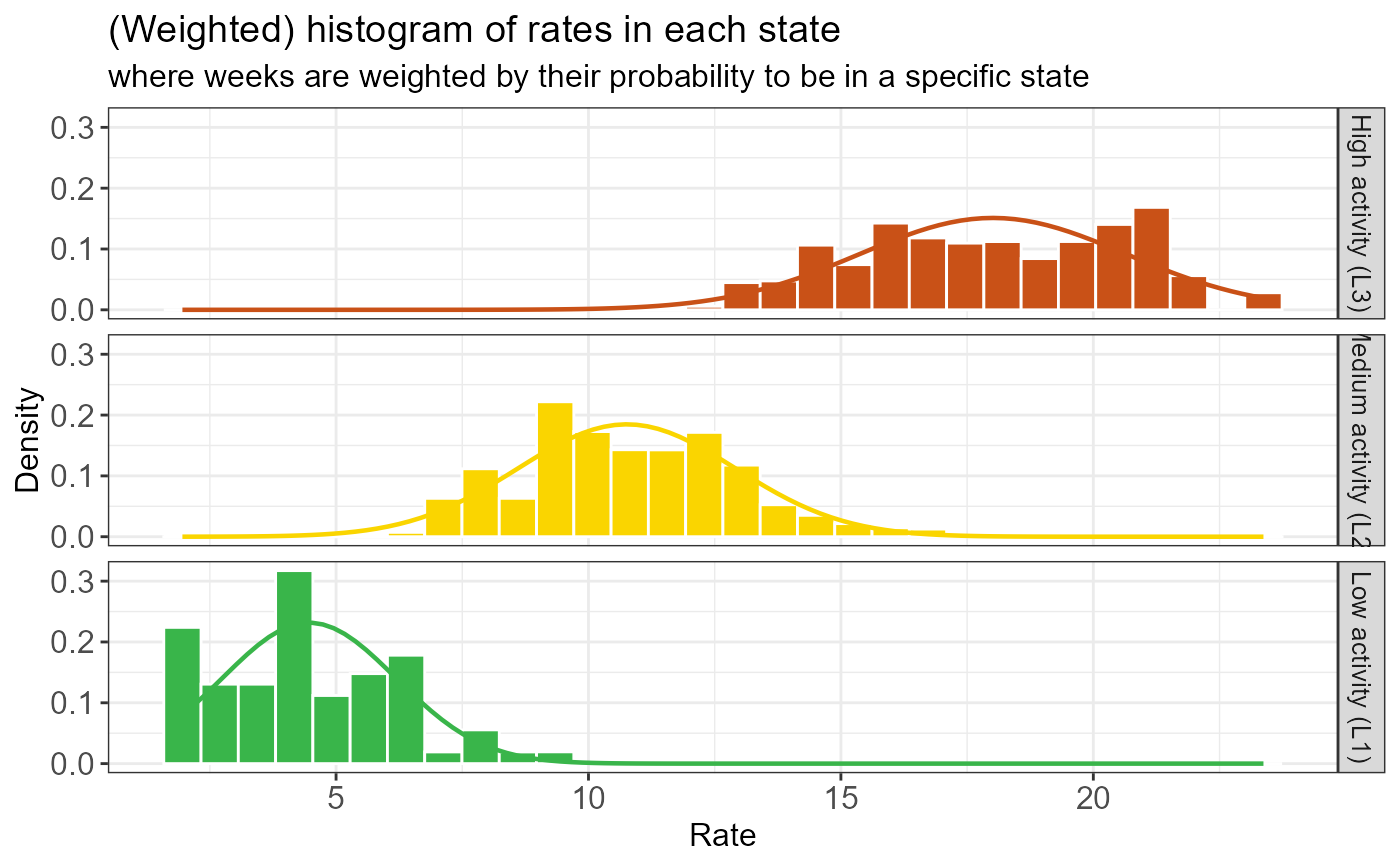
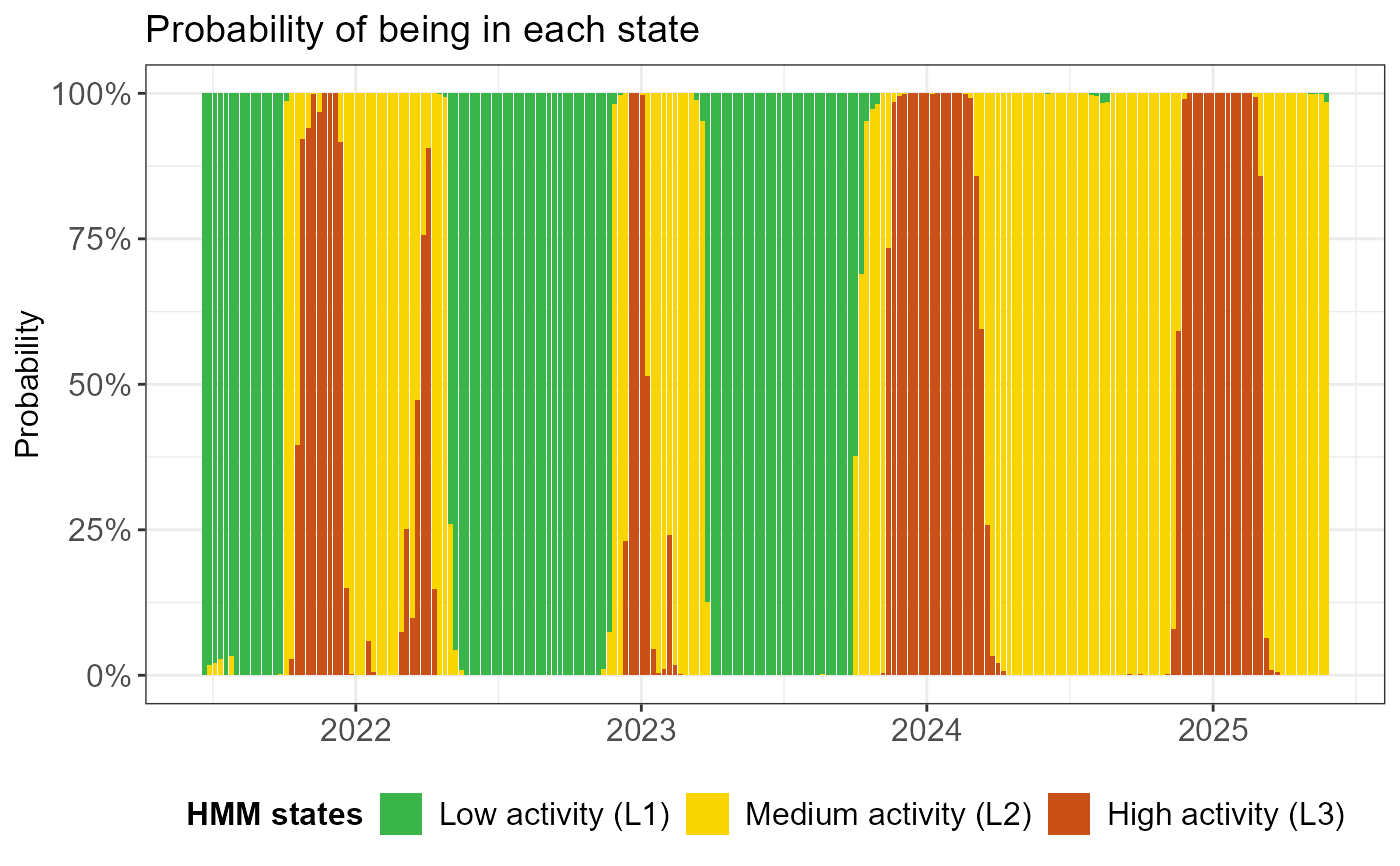
# Fit a 3-state HMM to (continuous) rate data
fit <- run_hmm(df_sari_be, n_states = 3, type = "rate")
# Check state information
summary(fit)
#>
#> ========================================================
#> EpiQUEST hidden Markov model summary
#> ========================================================
#>
#> --- Model configuration --------------------------------
#> Type: Continuous (Gaussian)
#> Number of states: 3
#> Seasonal: FALSE
#> Number of observations: 206
#>
#> --- Estimated state parameters -------------------------
#> State Mean Standard deviation
#> L1 4.468 1.722
#> L2 10.758 2.159
#> L3 18.011 2.641
#>
#> --- Transition matrix ----------------------------------
#> State ToL1 ToL2 ToL3
#> FromL1 95.73% 4.27% 0.00%
#> FromL2 2.51% 91.01% 6.48%
#> FromL3 0.00% 11.32% 88.68%
#>
#> --- State distribution (observations) ------------------
#> State Total weight Proportion
#> L1 72.6 35.2%
#> L2 85.2 41.4%
#> L3 48.2 23.4%
#>
#> Note: Weights are posterior probabilities.
#> ========================================================
# Visualize state information
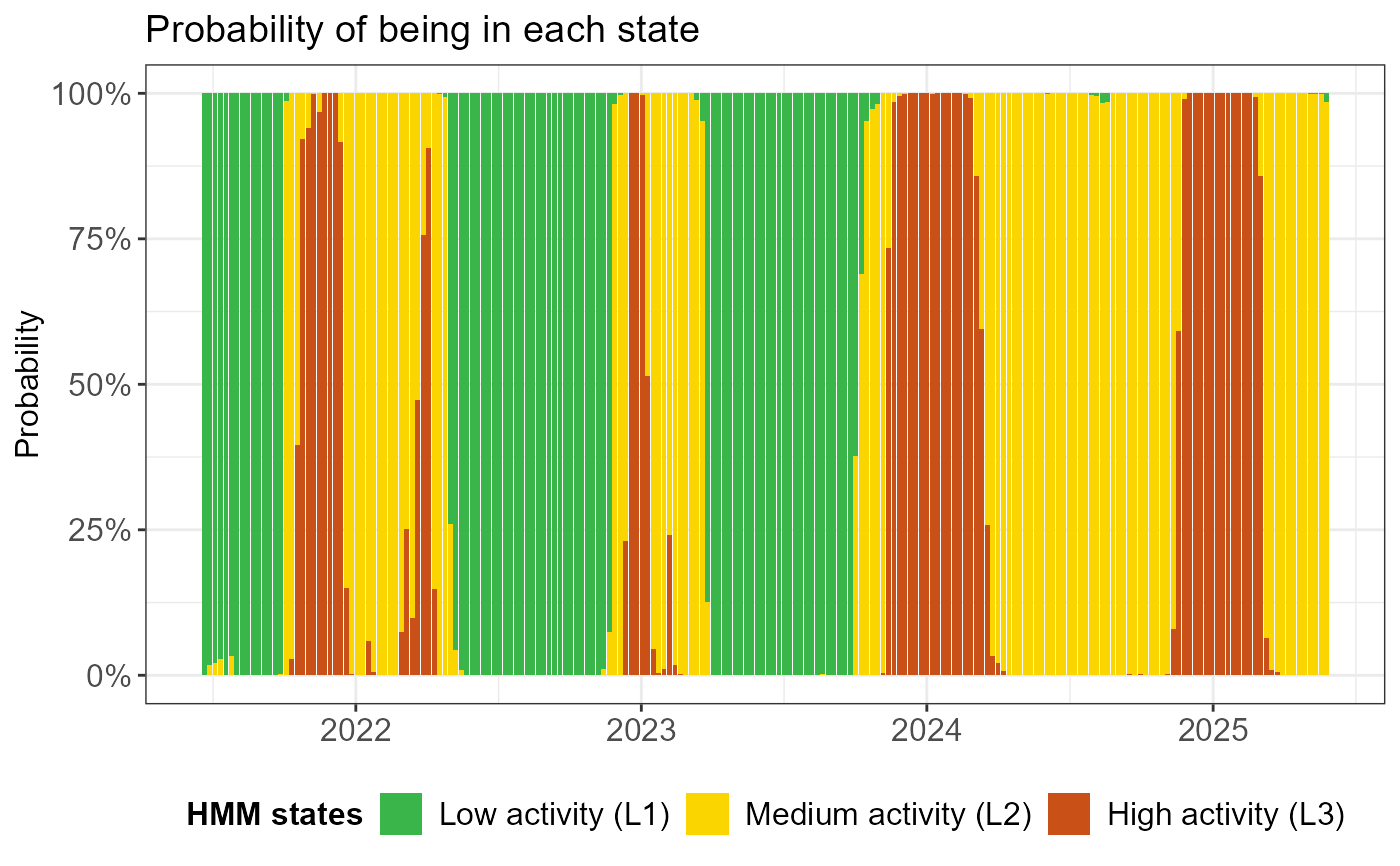
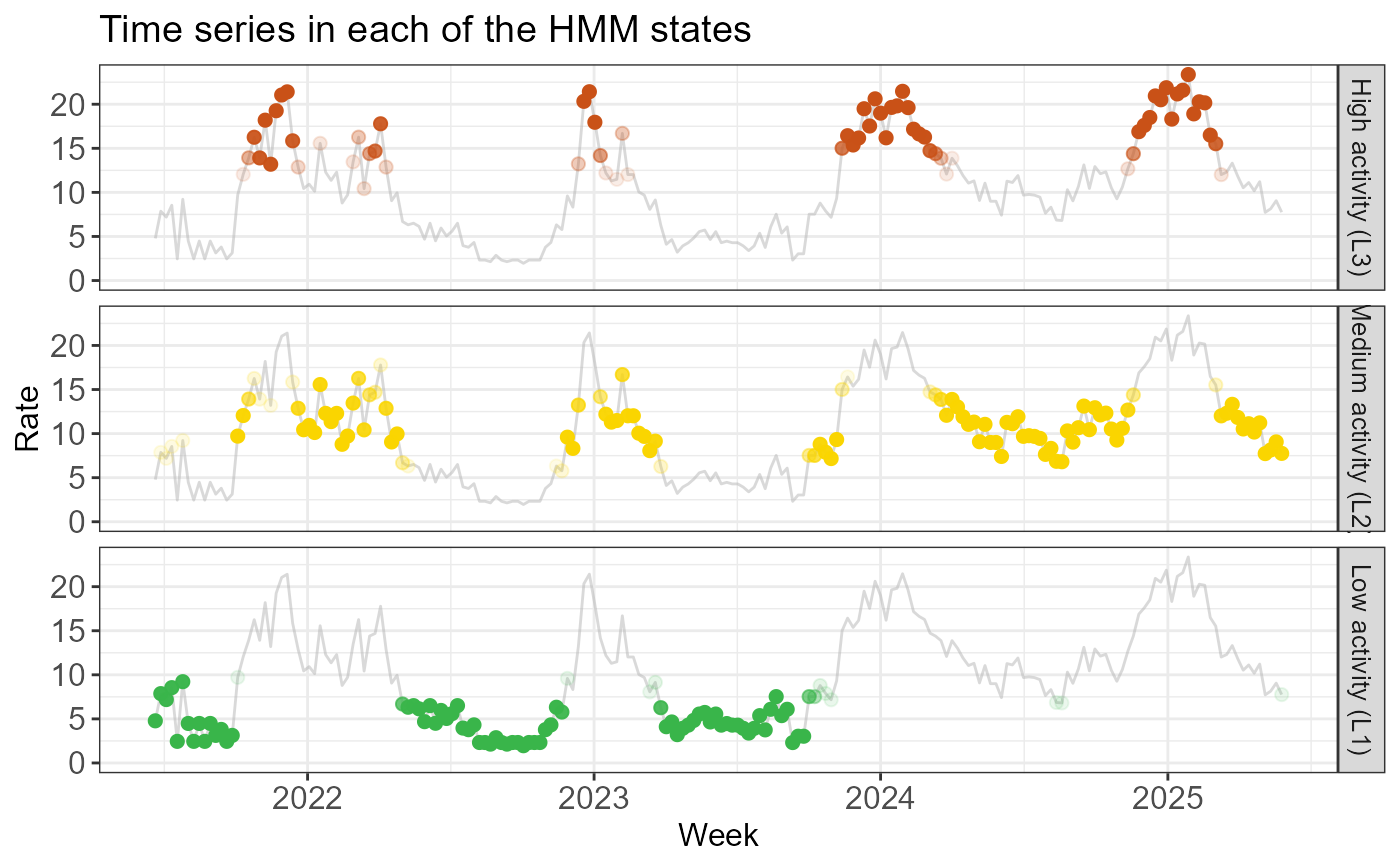
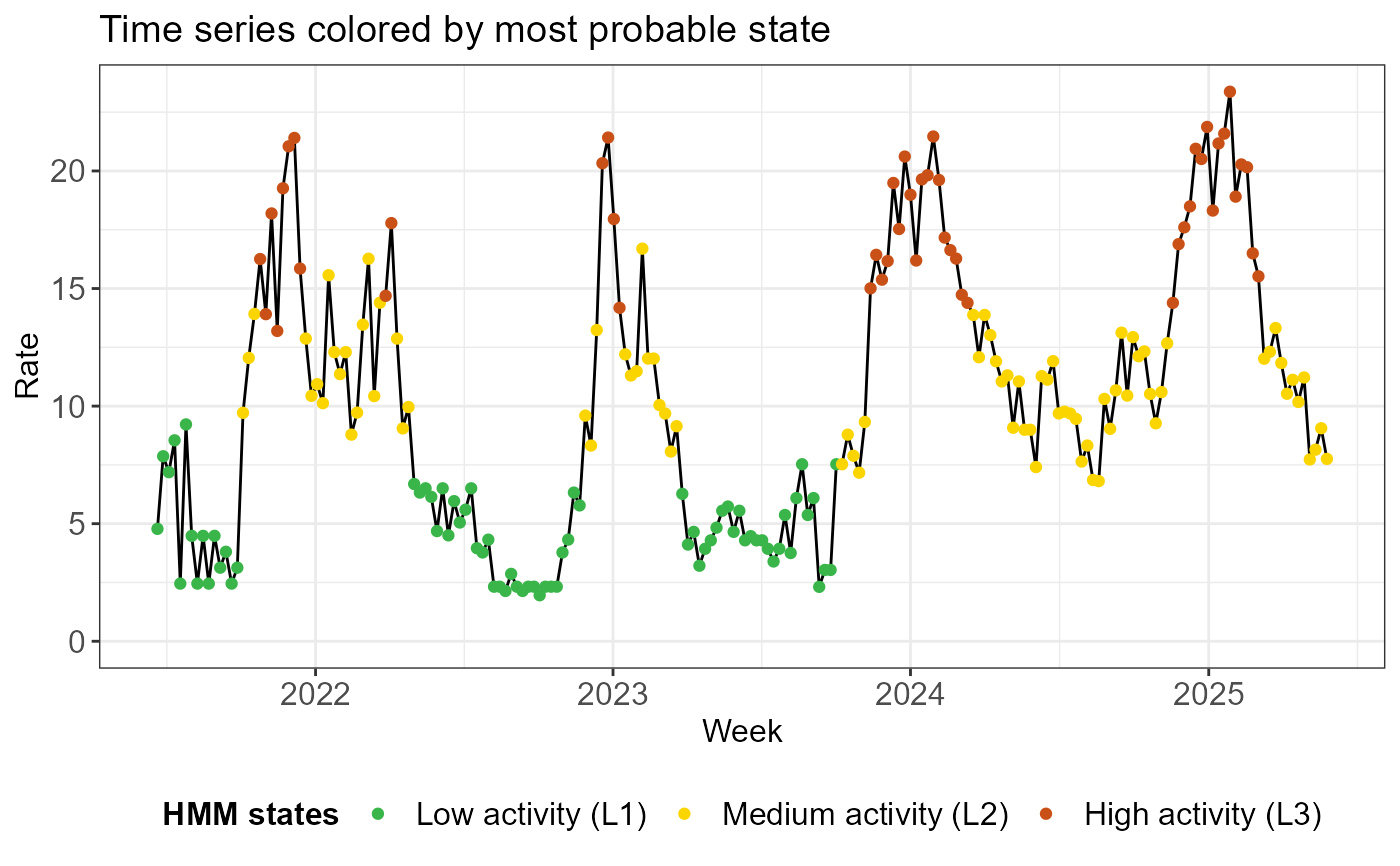
create_hmm_plots(fit)
 # Compute thresholds using the highest state (L3) as the epidemic state
# By default, epidemic_state_indices is the highest state
thresh <- run_threshold_computation(fit)
# Visualize theshold information
summary(thresh)
#>
#> ==============================================================
#> EpiQUEST threshold summary
#> ==============================================================
#>
#> --- Model configuration --------------------------------------
#> Type: Continuous (Gaussian)
#> Number of states: 3
#> Seasonal: FALSE
#> Number of observations: 206
#> State(s) defined as epidemic: L3
#>
#> --- Calculated QUEST thresholds ------------------------------
#> Level Quantile Value
#> Low 5% 13.881
#> Medium 70% 19.734
#> High 90% 21.408
#> Very high 99% 22.647
#>
#> Note: Thresholds calculated using weighted ECDF
#> based on posterior probabilities of epidemic state(s).
#> ==============================================================
# Visualize theshold information
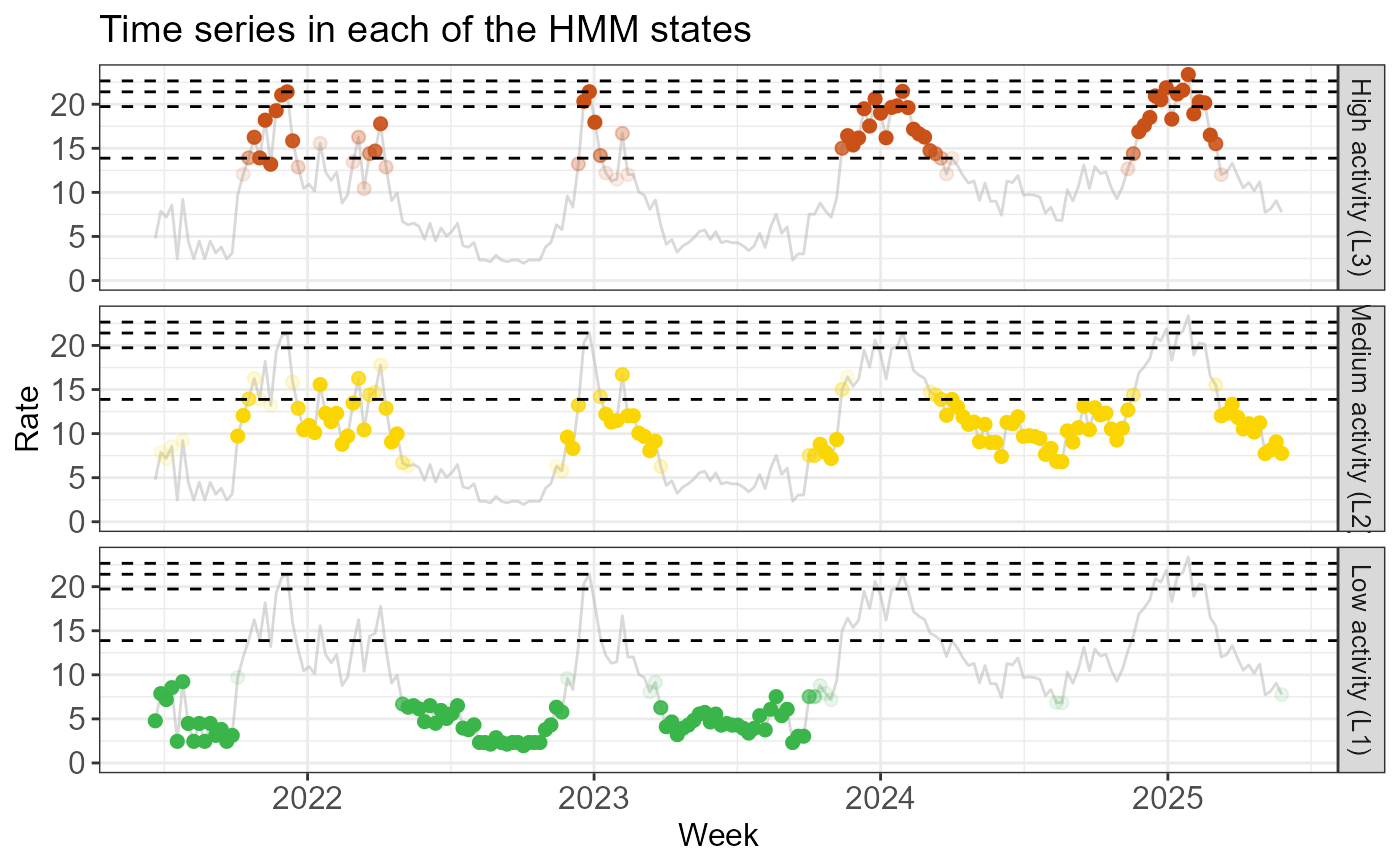
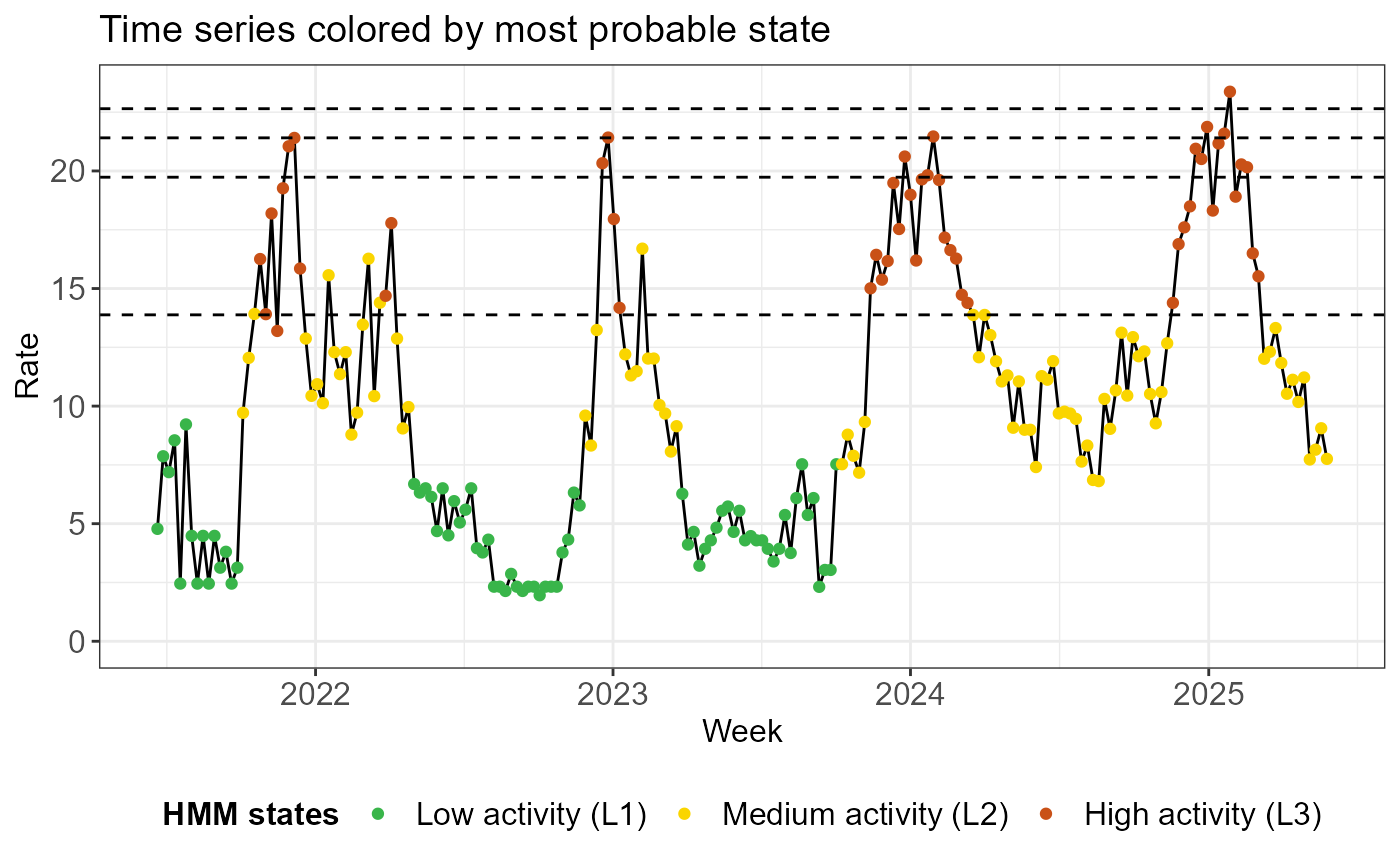
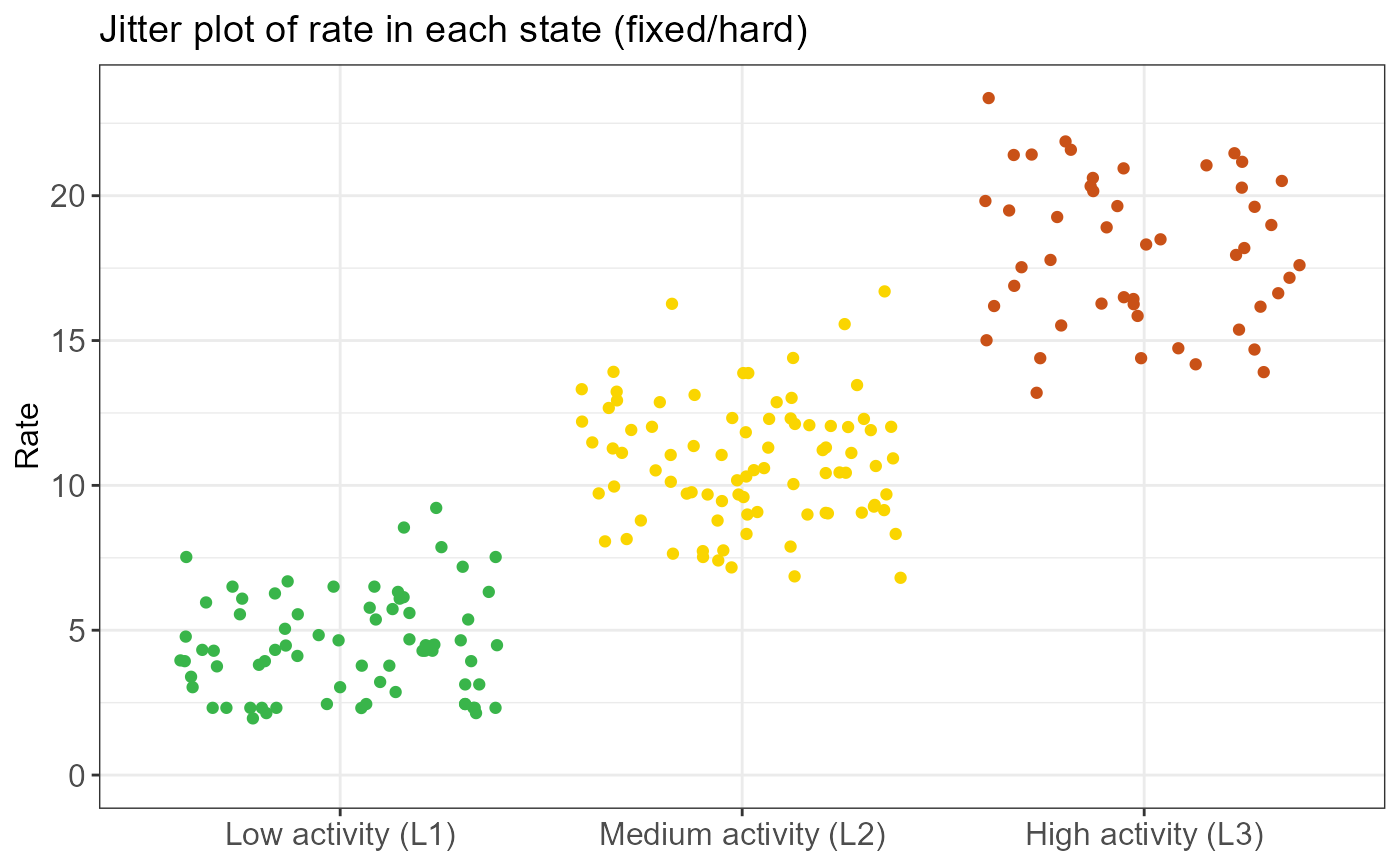
create_threshold_plots(thresh)
# Compute thresholds using the highest state (L3) as the epidemic state
# By default, epidemic_state_indices is the highest state
thresh <- run_threshold_computation(fit)
# Visualize theshold information
summary(thresh)
#>
#> ==============================================================
#> EpiQUEST threshold summary
#> ==============================================================
#>
#> --- Model configuration --------------------------------------
#> Type: Continuous (Gaussian)
#> Number of states: 3
#> Seasonal: FALSE
#> Number of observations: 206
#> State(s) defined as epidemic: L3
#>
#> --- Calculated QUEST thresholds ------------------------------
#> Level Quantile Value
#> Low 5% 13.881
#> Medium 70% 19.734
#> High 90% 21.408
#> Very high 99% 22.647
#>
#> Note: Thresholds calculated using weighted ECDF
#> based on posterior probabilities of epidemic state(s).
#> ==============================================================
# Visualize theshold information
create_threshold_plots(thresh)